
Financial advisor website design
Financial advisor website design should make a careful reader comfortable taking the first step. The site says who you work with, who will actually look after them, how a relationship begins and which qualifications you hold, written as plain facts. It feels steady, precise and personal, with one clear way to start a conversation.
What a financial advisor's website needs.
Who you work with, said precisely
"We help people reach their goals" could describe any advisor. A reader decides faster when the first screen names the kind of client you serve and the moments you are usually brought in for, such as selling a business, changing careers or planning for a growing family. We write it from the clients you want more of, in their own words, and without any statement about returns, performance or results of any kind.
Clarity about who looks after the client
Clients want to know whose phone rings. If you work alone, the site says so and explains how cover works when you are away. If you work with a team, it shows who does what: who meets the client, who prepares documents and who answers routine questions. Every profile uses a real photograph and states each person's role and qualifications as facts. A reader should never have to guess who they will be talking to.
How a relationship begins, step by step
The first meeting is the biggest unknown for a new client. We map it with you as a short sequence: how they get in touch, what the first conversation covers, what you will ask them to bring, what they receive afterward and when they decide whether to go ahead. We call this the first-meeting map. It removes the guesswork that keeps careful people from booking and, if it is true of your practice, states that the first step commits them to nothing beyond a conversation.
Credentials stated as verifiable facts
Designations, licenses and registrations go on the page exactly as they are held, with the issuing body named and, where you choose, a link to the public register where a reader can check them. Years in practice and past roles appear as dates and titles, not adjectives. We take every fact from you and from documents you share, and nothing is published until you have confirmed it line by line with us.
Disclosures that fit the design
Advisors often have notices and disclosures that must appear on their sites. We do not write or summarize them: review the rules of your regulator at the source and give us the exact wording you need. We then design a calm, readable place for it, on each page or in the footer as required, so it is present and legible without crowding out the message the reader came to your site for.
Articles in your voice, not product pages
Short pieces on how you think about a decision, or the questions you ask before a first meeting, show your judgment better than any brochure. We plan a few with you, each one dated, written as your perspective, approved by you and put through whatever review your firm or regulator requires. They sit away from the contact path, so a reader who is ready to talk can act without wading through reading first.
A steady, personal identity
Many advisor sites look alike: skylines, handshakes and charts that climb. We design around you instead: your name, a typeface with quiet authority, a calm color system and real photographs that show the person a client will sit down with. The site should feel like a well-run office, ordered and unhurried, so the reader's attention stays on one question: whether you are the right person to talk to, and when to call.
One example, in full.

Julia Sandberg Wealth advisor
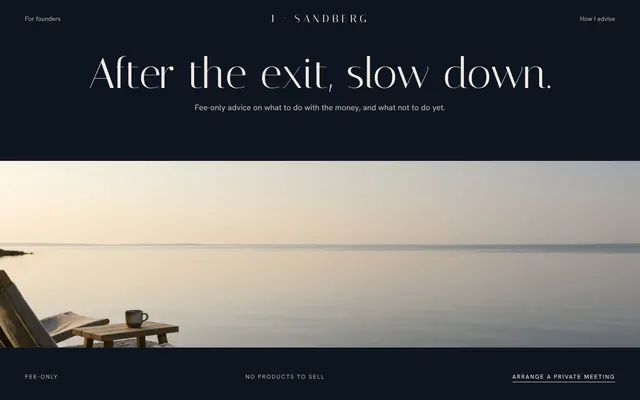
Julia Sandberg is a fictional wealth advisor from our concept set, not a client. For a profile like hers, we would lead with who she advises and a short first-meeting map on the home page, set her qualifications directly under her photograph as facts a reader can check, and keep one calm next step, a conversation, on every page.
Website designed and built by us.
More examplesQuestions financial advisors ask.
Can you write about investments or planning strategies on my site?
No. We write the structure, the headlines and the plain description of how you work, from interviews and material you approve. Anything about products, strategies or markets comes from you and goes through any review your firm requires. We do not give financial guidance, and the site makes no claims about returns.
Are there rules about what an advisor's website can say?
In most places, yes, and they depend on your registration, your firm and your jurisdiction. We do not summarize them. Review the rules of your regulator at the source and tell us what the site must include or avoid; we design so those requirements fit cleanly into the pages.
I work within a larger firm. Can I still have my own site?
Often, yes, though your firm may have its own policy on personal sites, so check it first. If it is allowed, we build a site about you and the clients you serve and allow time for whatever your firm needs to see and sign off before anything is published.
Should my site show client reviews?
Whether you may depends on the rules that apply to you, checked at the source. If you may and choose to, we give each review exact attribution and a calm place on the page. If not, a precise description of who you serve and how you work carries the trust on its own.
Can clients book a first meeting online?
Yes. We can connect the booking button to the scheduling tool you use and add a short page that explains what the first meeting covers and what to bring. If you prefer a call or an email before any meeting, the site points there instead and says so clearly.
Do I need a separate site for each type of client I serve?
Usually not. One site with a clear statement of who you serve, and a page for each main type of client, keeps your name and identity consistent. Separate sites tend to make sense only when the audiences have nothing in common and would never look for you in the same place.
What do you need from me to begin?
A short description of the clients you want more of, your qualifications and registrations as they appear officially, any disclosures you must show, photos you own and the scheduling or contact tools you use. We start with the message, then the identity, then the site.
Keep reading.
- Website design for lawyersAttorney website design for an individual lawyer has to make three things clear at once: the matters you handle, the clients you handle them for and how a prospective client gets in touch. Everything else, from your bio to your articles, exists to make that first contact feel like the right decision.Read
- Website design for therapistsA psychologist website has to help someone who may be anxious or tired decide whether to reach out. It should say who you work with, what a first session is like, which qualifications you hold and how to book, in a calm tone that never pushes. Our therapist website design starts from that reader.Read
- Personal brand website designMessage, identity and website created as one project for experts who sell what they know, so the right people understand your work and know how to start.Read
- Speaker website designA speaker website is read by organisers comparing a shortlist and by audience members who heard you yesterday. Good speaker website design gives the first group talk pages, video and booking details in one visit, and gives the second a reason to stay in touch, so a talk today can lead to the next invitation.Read
Tell us who you advise.
Share who your clients are, how a relationship with you begins and what the site should make clearer. We come back with a proposed scope, and nothing is agreed until you approve it.
Request a quote