
Speaker website design for keynote speakers
A speaker website is read by organisers comparing a shortlist and by audience members who heard you yesterday. Good speaker website design gives the first group talk pages, video and booking details in one visit, and gives the second a reason to stay in touch, so a talk today can lead to the next invitation.
What a speaker website needs.
Talks presented as products with a name and a promise
Organisers shortlist by topic before they compare people, so each talk needs its own page with a title, a one-line promise for the audience, who it suits and the formats it comes in, such as a keynote, a workshop or a fireside conversation. Concept example, fictional speaker: “The Quiet Meeting: how to run decisions without the loudest voice winning. For leadership offsites, 45 minutes or a half-day workshop.” A talk page an organiser can forward to a committee saves you a round of emails.
A reel cut for the decision an organiser makes
An organiser watches video to answer one question: will this person hold my room? Plan the reel as four short moments rather than a montage: your first thirty seconds on stage, one complete story, a wide shot that shows the audience reacting, and a moment of answering a question live. Put the reel near the top of the site and longer clips on each talk page. The site embeds video from the service you already use, so you can replace the reel without a redesign.
The organiser’s details, answered before they ask
Every organiser needs the same practical facts, and each one they have to email about is a small reason to pick someone else. Collect them on one page: formats and lengths, the audience sizes you are used to, languages you speak in, where you travel from, whether you present in person or remotely, technical needs on stage, and a one-sheet they can download and attach to an internal proposal. Keep the page current, because an outdated detail costs more trust than a missing one.
A date enquiry that asks for what you need to reply
A keynote speaker website should let an organiser ask about a date in one step, from any page. The enquiry asks only what you need to give a specific answer: the event name, the date or date range, the city or format, the audience and its size, the topic they have in mind and their budget range, which they type in their own words. Say who replies and roughly what the reply contains, so the organiser knows the request did not disappear.
Past stages written as evidence, not a logo wall
A row of event logos shows where you have been but not what happened there. For your strongest appearances, write one line each: the event, the audience, the talk you gave and, where the organiser has agreed, a sentence from them about how it went. Place those lines next to the talk they relate to. An organiser looking at a specific talk wants to know it has worked for an audience like theirs, and that is the fastest way to show it.
A bio in three lengths and photographs ready to use
Programmes, press releases and introductions on stage all need a bio, and each needs a different length. Provide one line for a programme listing, one paragraph for a website or brochure, and a full version for a press kit, all written in the third person and saying the same thing at different depths. Add a small set of approved photographs in horizontal and vertical crops, named so an organiser can find the right one without asking you.
A page for the audience after you step off stage
After a good talk, people in the room search for your name that evening. Most speaker sites send them to a page written for organisers, and they leave. Give them a page of their own: the resources you promised from the stage, the book or longer piece behind the talk if there is one, and a way to hear from you again. Some of those listeners organise events themselves, which is how a single talk can quietly lead to the next booking.
One example, in full.
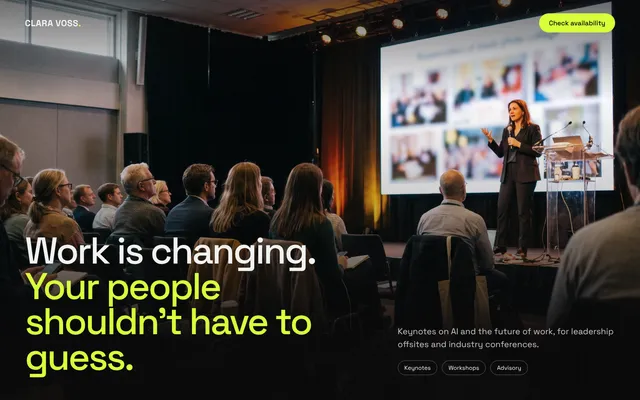
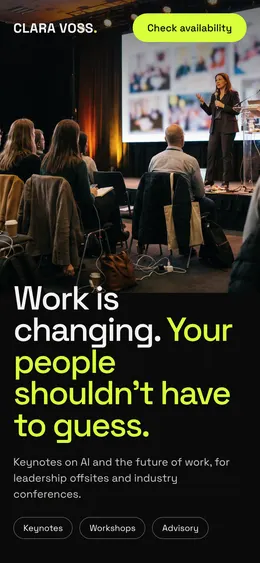
Clara Voss Keynote speaker
The website for Clara Voss, a fictional keynote speaker, leads with her keynotes on AI and the future of work and keeps availability one click from the first screen, so an organiser can ask about a date without searching. Talks come first, the enquiry is never more than one step away.
Website designed and built by us.
More examplesQuestions speakers ask.
What should a speaker website include?
A page per talk with a title, a promise and formats; a reel near the top; one page of practical details for organisers with a downloadable one-sheet; a date enquiry reachable from every page; past stages written as evidence; a bio in three lengths with photographs; and a page for audience members who arrive after a talk.
Is a keynote speaker website different from an author’s or expert’s site?
The structure overlaps, but the order changes. A keynote speaker website leads with talks and video, because organisers are the main buyers. An author who speaks often leads with the book and treats talks as one way to meet the ideas. An expert who speaks occasionally keeps talks as one section of a wider professional site.
Can an organiser request a date directly from the site?
Yes. The enquiry asks for the event, date, audience, format and budget range, so your reply can be specific. If you work with an assistant or an agent, enquiries can go to them with you copied. The site never confirms a date on its own; a person always replies.
Where does my showreel live?
It is embedded from the video service you already use, which keeps the website quick to load and lets you replace the reel whenever you have better footage. We design the space around it, write the short line above it and plan where longer clips sit on each talk page.
Do I need a separate page for each talk?
If your talks serve different audiences or industries, yes: each page can be shared with a committee on its own. If you give one signature talk with variations, one well-organised page with the formats listed is enough. Separate pages also help the right organiser find a talk when they search for its topic.
Can the site work alongside a speakers’ bureau?
Yes. The site carries the one-sheet, bio and photographs a bureau needs, and the enquiry can route requests the way your agreement with them requires. We make sure the talk titles and descriptions match wherever you are listed, so an organiser sees one consistent profile.
How much does speaker website design cost?
It depends on scope: the number of talk pages, how much video and writing is involved, and whether your message and identity are new or already settled. Share your talks and how organisers reach you today, and we reply with a scope and a quote before anything is agreed.
I am just starting to speak. Is a full site too early?
Not if it is honest about where you are. A first speaker site can be a single page with one talk, a short clip, a bio and an enquiry, built so that new talks and stages slot in later. What matters early is that the topic and promise are clear, because those are what get you the first invitations.
Keep reading.
- Personal brand website designMessage, identity and website created as one project for experts who sell what they know, so the right people understand your work and know how to start.Read
- Website design for authorsA writer website gives readers, organizers and journalists one place to find your books, learn who you are and reach you. It shows the current book first, makes buying it one click away, offers a press page that answers questions before they are asked and invites readers onto your mailing list.Read
- Website design for coachesA coach website works when the right reader recognises their situation in the first sentence, sees how your coaching runs and finds one clear way to book a first call. Life, executive and business coaches need different paths to that call, so we design the path for the person who actually decides to hire you.Read
- Website design for consultantsA consultant website has to answer one question before a buyer opens a second page: is this the person to call about our problem. Good consultant website design names that problem in the buyer’s words, shows how an engagement runs and gives the reader something they can forward to the colleague who signs.Read
Tell us what you speak about.
Share your talks, the events you speak at and how organisers contact you today. We reply with the scope before anything is agreed.
Request a quote