
Consultant website design for freelance and independent consultants
A consultant website has to answer one question before a buyer opens a second page: is this the person to call about our problem. Good consultant website design names that problem in the buyer’s words, shows how an engagement runs and gives the reader something they can forward to the colleague who signs.
What a consulting website needs.
The problem, stated the way a buyer says it on the phone
Buyers rarely search for a method. They search for the situation they are stuck in. Before any design work, write down the sentence a client used the last time they called you, and build the first screen from it. Concept example, fictional consultant: “Your sales team hits its numbers only when the founder joins the call.” That line does more than a service name such as sales enablement, because the right reader sees their own week in it and the wrong reader moves on quickly.
Two readers: the person who finds you and the person who signs
In most companies the person who finds a consultant is not the person who approves the budget. Your site has to serve both. Our test is simple: could the finder forward one page with a single line, such as “this is the person I mentioned”, and have the signer understand the problem, the approach and the next step without a call? If the answer is no, the page is written for you, not for them. We check every consultant site against that test before launch.
Engagement shapes a buyer can picture and plan for
Describe each way of working with you in the same four parts: what usually triggers it, what the client provides, what you deliver, and how it ends. Concept example, fictional consultant: a two-week diagnostic that ends with a written recommendation; a project with a fixed scope and a closing review; ongoing advice with a monthly session. When the shapes are clear, a buyer can plan for them internally, and you stop answering the same three questions in every first conversation.
Cases written as situation, decision and outcome
A logo wall tells a buyer who paid you. A case tells them what you did. Write each case in three short parts: the situation the client was in, the decision you helped them make, and what changed afterwards, in the client’s words where they allow it. Anonymise when you must, describing the company by sector and size instead of name. Two or three well-written cases persuade more than ten thin ones, and they are exactly what a finder forwards to a signer.
A point of view a peer could disagree with
Clients pay a consultant for judgement, and judgement shows up as a position. Give your site one page that states what you believe about your field that others do not, why you believe it, and what it means for a client’s next decision. If no peer would argue with it, it is not yet a point of view. Concept example, fictional consultant: “Most restructurings fail in the second month, not the first, so that is where we spend our time.”
Credentials mapped to the claims they support
A list of past roles reads like a CV. Instead, map evidence to claims. Write the three claims your site makes, such as you understand this sector, you have done this kind of work, and others trust your judgement, and place beside each one the proof that supports it: a role held, a sector you have worked in, a publication or a client you can name with permission. Any claim left without proof is either cut or rewritten until it can be shown.
A freelance consultant website with one way to start
Freelance and independent consultants often bury the next step under several contact options. Pick one starting point that carries little risk for the buyer, such as an introductory call with a stated agenda or a short paid diagnostic, and repeat it on every page with the same words. Say what happens after someone asks: who replies, what you will want to know, and what they receive. A buyer who knows what the first step involves is far more likely to take it.
One example, in full.
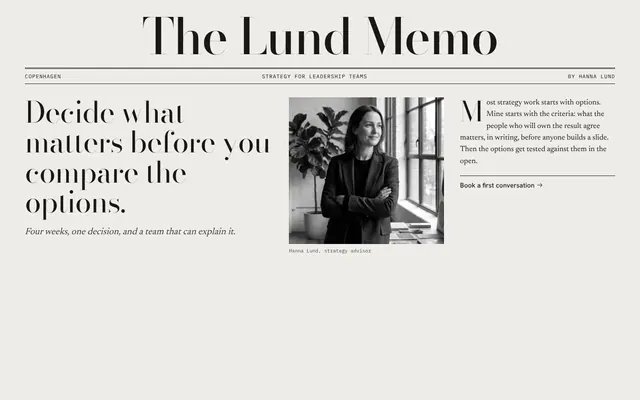
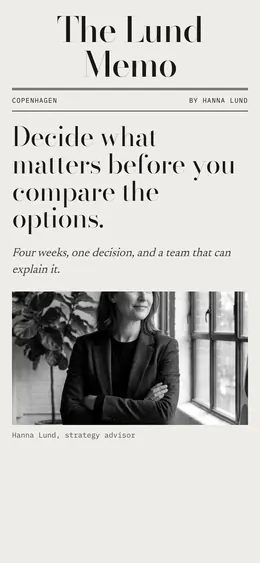
Hanna Lund Strategy advisor
The website for Hanna Lund, a fictional strategy advisor, is built like a front page, because her work starts with what matters most: the headline is the problem she solves and every section is a story under it. It shows the forwarding test in practice, since any one section can be sent on its own.
Website designed and built by us.
More examplesQuestions consultants ask.
What should a consultant website include?
A first screen that names the problem you solve in the buyer’s words, the ways an engagement can run, two or three cases, your point of view, credentials placed next to the claims they support, and one way to start. A short about page explains why you do this work. Everything else can be added later.
Should a consultant publish case studies?
Yes, when clients allow it, and anonymised when they do not. A case written around the situation, the decision and the outcome persuades a buyer more than a list of names. If you cannot publish any case at all, describe the typical engagement in detail instead, labelled as typical rather than as a real client.
I serve several industries. Should the site split by sector?
Only if the buyers in each sector use different words or need different proof. Often one clear problem statement works across sectors, with a short page per sector added where the language changes. Start with one, watch which sector actually contacts you, and add sector pages when there is something specific to say.
Is a freelance consultant website different from a firm’s site?
Yes. A freelance consultant is hired as a person, so the site leads with your judgement, your voice and your face. A firm is hired as a team and a process. We decide with you whether the name on the site is yours or the practice’s, and design it so that adding associates later does not mean starting again.
How much does consultant website design cost?
It depends on scope: the number of engagement pages and cases, whether the positioning and identity are new, and how much writing we take on. Describe what you are hired for and who hires you, and we reply with a scope and a quote before anything is agreed.
Do I need a blog or articles on a consulting website?
Not to launch. A few pieces that show how you think about your clients’ problems help a buyer trust your judgement, but an archive that stops after three months looks worse than none. We plan with you which pieces are worth writing first and where they sit on the site.
Can you write the copy, or do I need to supply it?
We write it with you. The work begins with the sentence that describes what you solve, then the identity, then the website, and you approve each phase before the next. We interview you for the material, so you review and correct text rather than starting from a blank page.
Can the site link to my LinkedIn profile?
Yes. Many buyers check a consultant’s LinkedIn profile after visiting the site, so the two should tell the same story in the same words. We keep the site as the place where the full argument lives and make sure your profile points back to it, rather than the other way round.
Keep reading.
- Personal brand website designMessage, identity and website created as one project for experts who sell what they know, so the right people understand your work and know how to start.Read
- Speaker website designA speaker website is read by organisers comparing a shortlist and by audience members who heard you yesterday. Good speaker website design gives the first group talk pages, video and booking details in one visit, and gives the second a reason to stay in touch, so a talk today can lead to the next invitation.Read
- Website design for authorsA writer website gives readers, organizers and journalists one place to find your books, learn who you are and reach you. It shows the current book first, makes buying it one click away, offers a press page that answers questions before they are asked and invites readers onto your mailing list.Read
- Website design for coachesA coach website works when the right reader recognises their situation in the first sentence, sees how your coaching runs and finds one clear way to book a first call. Life, executive and business coaches need different paths to that call, so we design the path for the person who actually decides to hire you.Read
Tell us what you solve.
Describe the problem you are hired for and who hires you. We reply with the scope before anything is agreed.
Request a quote