
Coach website design for life, executive and business coaches
A coach website works when the right reader recognises their situation in the first sentence, sees how your coaching runs and finds one clear way to book a first call. Life, executive and business coaches need different paths to that call, so we design the path for the person who actually decides to hire you.
What a coaching website needs.
A niche sentence built from who, when and what changes
Most coaching sites open with a label: life coach, leadership coach, mindset coach. A label tells a visitor what you call yourself, not whether you are for them. Write the first sentence in three parts instead: who you coach, the moment they are in, and what is different after working with you. Concept example, fictional coach: “Coaching for engineers who have just been made managers, so the first team meeting feels like yours.” If a stranger can repeat your sentence back after one read, it is ready for the first screen.
First-call path for a life coach website
A life coaching client usually decides alone, often late in the evening, and often after weeks of hesitating. The path has to lower the stakes. Checklist: the first screen names a situation, not a feeling; one short paragraph says what a session is like; a single line explains what the first call is for and that there is no obligation; the button reads the same on every page. Concept example, fictional coach: “Coaching for people returning to work after a long break. Book a 30-minute call to talk through where you are.”
First-call path for an executive coach website
An executive coaching engagement often has two readers: the leader being coached and the person who sponsors the work, such as a chief people officer. Checklist: one line for each reader on the first screen; a page that explains how sessions stay private and what the sponsor hears about progress; the stages of an engagement, from intake to closing review; a call described as a conversation about fit. Concept example, fictional coach: “For newly appointed directors and the HR leaders who support them in their first year.”
First-call path for a business coach website
A business owner reads a business coach website looking for one answer: what will be different in the business, not just in me. Checklist: name the stage of company you work with, such as a founder with a first team of ten; list three problems in the owner’s own words; show the rhythm of the work across a quarter; offer a call with a stated agenda, for example “we look at your next ninety days together”. Concept example, fictional coach: “Coaching for owners who are still the bottleneck in every decision.”
Programmes a reader can picture before buying
One-to-one, group or company programmes all need the same four facts on the page: who the format suits, how often you meet and for how long, where sessions happen, and what someone has at the end that they did not have at the start. Write each programme as a short walk through the first month. A reader who can imagine week two is far closer to booking than one who has only read the name of the programme and a list of benefits.
Proof and credentials placed where doubt appears
Proof works best next to the claim it supports, not collected on one page at the end. Put a client’s words, shared with their permission and attributed as precisely as they allow, beside the programme they took. Put your accreditation and training next to the description of your method, because that is where a careful reader starts to ask how you were trained. A short story about why you coach belongs on the about page, written as the reason behind your niche rather than as a career summary.
A way to stay close for readers who are not ready
Many visitors to a coach website are months away from booking. Give them something smaller than a call: a short letter you send when you have something worth saying, a page of questions to answer on their own, or an article that shows how you think about the problem they have. Keep it to one offer, placed after the programmes, so it never competes with the first-call button. The goal is that they remember your name when the moment to book finally arrives.
One example, in full.
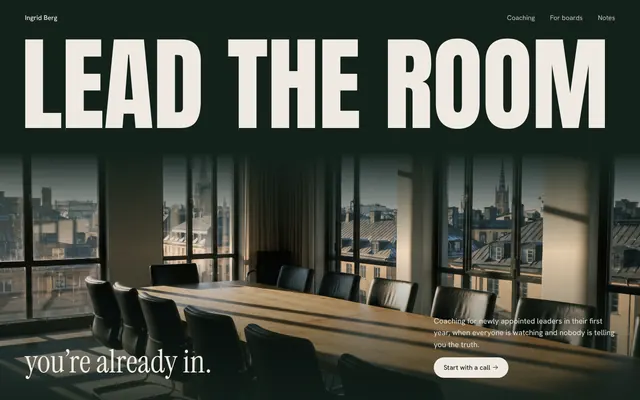
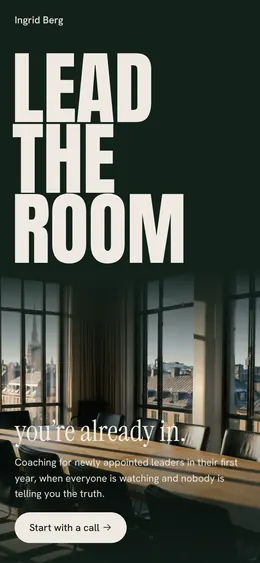
Ingrid Berg Executive coach
The website for Ingrid Berg, a fictional executive coach, sets LEAD THE ROOM over the boardroom, names who it is for in one sentence, leaders in their first year, and offers a single next step: a call. It follows the executive path above, with one line for the leader and one route to that conversation.
Website designed and built by us.
More examplesQuestions coaches ask.
What should a coach website include?
At minimum: a first sentence that names who you coach and what changes, a page per programme, your method and credentials, words from clients shared with permission, and one booking path repeated on every page. Add an about page with the reason behind your niche, and a small offer for readers who are not ready to book yet.
I am a life coach and an executive coach. One site or two?
Usually one site with two clearly separated paths, because both readers need to trust the same person. The paths share your story and method but use different words, different proof and a different description of the first call. Two sites make sense only when the audiences would be put off by seeing each other’s offer.
Can my coach website take bookings for discovery calls?
Yes. The site can link to or embed the scheduling tool you already use, so a visitor picks a time without leaving the page. We write the short note beside the button that says what the call covers, how long it lasts and what happens after it, because that note often matters more than the calendar itself.
Do I need professional photographs for a coaching site?
Real photographs of you build more trust than stock images, and they do not need to be elaborate. A few natural portraits and one image of you working with someone, taken with consent, are enough to start. The images in our studio concepts are illustrations; your own site should use real photographs of you.
How much does coach website design cost?
It depends on the scope: how many client paths the site needs, how many programme pages, and whether the message and identity are new or already settled. Tell us how you coach and who hires you, and we reply with a scope and a quote before anything is agreed.
What do you need from me to start?
A conversation about who you coach, how sessions run and which clients you want more of. We start with the sentence that describes your coaching, then the identity, then the website, and you approve each phase before the next one begins. Material you already have, such as programme notes or client words, helps.
Do I need a blog on my coaching website?
Not to launch. A small number of articles that answer questions your clients ask in first calls is more useful than a long archive written to fill a calendar. If writing is not how you like to share your thinking, a short letter to a list of readers can do the same job with less effort.
How is this different from a coaching website template?
A template gives you a layout and leaves the message to you. We define the message first, design an identity that fits it and then build the site around the path your clients take to a first call. The result is a coaching website that reads as yours, not as a theme with your name added.
Keep reading.
- Personal brand website designMessage, identity and website created as one project for experts who sell what they know, so the right people understand your work and know how to start.Read
- Speaker website designA speaker website is read by organisers comparing a shortlist and by audience members who heard you yesterday. Good speaker website design gives the first group talk pages, video and booking details in one visit, and gives the second a reason to stay in touch, so a talk today can lead to the next invitation.Read
- Website design for authorsA writer website gives readers, organizers and journalists one place to find your books, learn who you are and reach you. It shows the current book first, makes buying it one click away, offers a press page that answers questions before they are asked and invites readers onto your mailing list.Read
- Website design for consultantsA consultant website has to answer one question before a buyer opens a second page: is this the person to call about our problem. Good consultant website design names that problem in the buyer’s words, shows how an engagement runs and gives the reader something they can forward to the colleague who signs.Read
Tell us who you coach.
Share who your clients are, how you work with them and what your site should do better. We reply with the scope before anything is agreed.
Request a quote